North Fork Wind v Knox County Nebraska: Review of court decision
Lisa Linowes|Sep 16, 2026
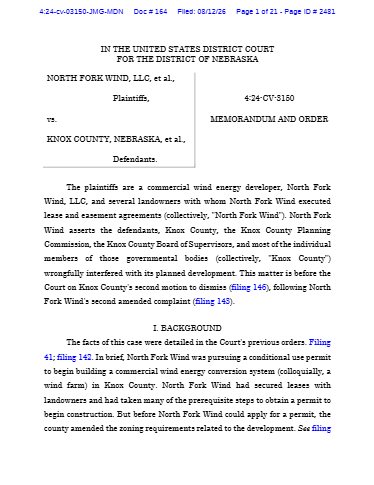
The US District Court for the District of Nebraska has rejected several major claims brought by North Fork Wind against Knox County after the county adopted increasingly restrictive wind-energy zoning rules and ultimately banned new commercial wind development. Judge John M. Gerrard's August 12, 2026 order provides several important findings regarding the authority of local governments to regulate wind development. Windaction lists below each of the developers’ claims, the Court’s responses, and a brief summary of what the order means. The full order can be accessed from the document link on this page. Note: North Fork Wind is owned by National Grid Renewables Development LLC, a renewable energy company that was rebranded to Geronimo Power in 2025 following its acquisition by Brookfield Asset Management.
The US District Court for the District of Nebraska has rejected several major claims brought by North Fork Wind against Knox County after the county adopted increasingly restrictive wind-energy zoning rules and ultimately banned new commercial wind development. Judge John M. Gerrard's August 12, 2026 order provides several important findings regarding the authority of local governments to regulate wind development. Windaction lists below each of the developers’ claims, the Court’s responses, and a brief summary of what the order means. The full order can be accessed from the document link on this page. Note: North Fork Wind is owned by National Grid Renewables Development LLC, a renewable energy company that was rebranded to Geronimo Power in 2025 following its acquisition by Brookfield Asset Management.
1. A wind project can prompt a county to change its zoning laws
Developer’s claim: North Fork Wind argued that Knox County’s zoning changes were improperly directed at its proposed project and were motivated by opposition to the development.
Court’s response: The court acknowledged that North Fork Wind’s project was the impetus for the zoning changes. But it held that it is not necessarily irrational or unconstitutional for a local government to amend its zoning laws in response to an unwanted pending or proposed development.
What it means: A county does not lose its zoning authority simply because a proposed wind project caused residents and officials to reconsider whether existing regulations were adequate.
2. Noise, shadow flicker, property values, aesthetics and safety are legitimate zoning concerns
Developer’s claim: North Fork Wind argued that the county lacked a sufficient basis for its restrictions and that the real purpose of the regulations was to stop its project.
Court’s response: The court found that concerns about declining property values, turbine noise, shadow flicker, viewshed impacts, crop-dusting safety and preservation of the county’s agricultural character were legitimate governmental interests supporting the ordinance.
The court further explained that legislative decisions may be based on rational speculation and do not necessarily require empirical proof in court.
What it means: Local officials are entitled to consider the real-world impacts of wind development when adopting zoning regulations. They do not have to prove each concern to the same evidentiary standard that would apply in a trial.
3. Allegations of hostility toward a wind project do not invalidate an ordinance
Developer’s claim: North Fork Wind pointed to statements by officials, the timing of the zoning changes, the severity of the restrictions and alleged bad faith as evidence that the county was targeting the company.
Court’s response: The court held that those allegations did not defeat the ordinance. Under the applicable constitutional standard, North Fork Wind still had to overcome the legitimate reasons supporting the county’s action.
What it means: A developer cannot invalidate a zoning ordinance merely by arguing that local officials or residents strongly opposed its project. If legitimate land-use reasons support the regulation, opposition to the project does not by itself make the law unconstitutional.
4. Organized public opposition is part of the legitimate zoning process
Developer’s claim: North Fork Wind argued that organized opposition to the project contributed to an unfair and improperly targeted process.
Court’s response: The court noted that Knox County held multiple public hearings before changing its regulations and found no extraordinary or unlawful governmental intervention. The fact that the county acted in response to vocal, organized opposition did not amount to a constitutional violation.
What it means: Residents have the right to organize, participate in hearings and urge their local government to change zoning rules in response to a proposed wind development.
5. State policies encouraging wind energy do not create a right to build a wind project
Developer’s claim: North Fork Wind argued that Nebraska laws encouraging renewable energy preempted Knox County’s decision to ban commercial wind development.
Court’s response: The court rejected that argument. Nebraska law requires counties to assess and evaluate renewable energy and authorizes them to encourage wind development, but it does not require counties to approve or accommodate commercial wind projects. The court concluded that the state left zoning authorities to decide where wind farms should be allowed and what restrictions should apply.
The court found no legislative intent preventing a county from prohibiting wind development if the county determines that it would be detrimental to the public good.
What it means: A state policy favoring renewable energy is not the same thing as a statutory right to construct a wind project. Local zoning authority remains important unless state law expressly removes it.
6. Local zoning authority can include prohibition, not merely regulation
Developer’s claim: North Fork Wind argued that the county had authority to “regulate” wind development but not to prohibit it entirely.
Court’s response: The court rejected that distinction. Nebraska law gives counties broad authority to “regulate, restrict, or prohibit” structures and land uses.
What it means: Where state law grants broad zoning authority, a county may have the legal power to determine that a particular industrial land use is inappropriate altogether—not merely dictate its setbacks or operating conditions.
Bottom line
The court did not decide whether Knox County’s renewable-energy ban was wise policy. Instead, it emphasized that courts do not sit as a “superlegislature” to second-guess legislative decisions simply because they may be controversial or disputed. Whether the ban is good public policy is a matter for the political process.
The decision reinforces a basic principle of local land-use law: wind developers do not have an automatic right to build simply because they have secured leases, invested money in a project, or operate in an industry favored by state energy policy. Local governments retain substantial authority to respond to proposed development and protect the health, safety and character of their communities.
The litigation is not over. North Fork Wind’s takings claim remains pending, along with several state-law claims that the court allowed to continue largely because Knox County did not properly seek their dismissal in its opening brief.