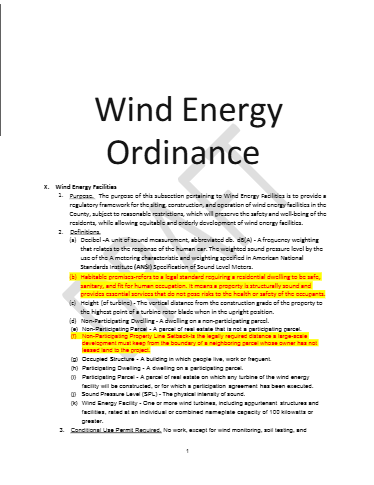
The draft wind energy ordinance in Dunn County, North Dakota, mandates significant setback distances for wind turbines to protect neighboring properties. Key distances include at least 1 mile for participating residences, 2 miles for nonparticipating residences, commercial, and public buildings, and specific distances for other areas like highways and sensitive sites. These setbacks can be reduced or waived through formal agreements between property owners and the permittee.
The draft wind energy ordinance in Dunn County, North Dakota, mandates significant setback distances for wind turbines to protect neighboring properties. Key distances include at least 1 mile for participating residences, 2 miles for nonparticipating residences, commercial, and public buildings, and specific distances for other areas like highways and sensitive sites. These setbacks can be reduced or waived through formal agreements between property owners and the permittee.
The wind energy ordinance under review by Dunn County North Dakota includes robust protections for neighboring properties including the following setback distances.
Setback requirements in the draft ordinance
Unless otherwise stated, distances are measured from the center of the turbine monopole.
Participating residences: At least 1 mile.
The participating property owner may agree to a shorter distance, but the setback may not be less than 1.1 times the total turbine height.
The ordinance also states that a variance may be granted if all legal owners of the affected structure agree in writing to waive the setback.
Nonparticipating residences: At least 2 miles.
The setback may be reduced or waived through a formal, legally binding agreement signed by the permittee and affected adjoining property owners with associated wind rights.
Commercial buildings and public buildings: At least 2 miles, with a greater distance required when necessary to comply with the ordinance’s sound limits.
Historical natural resources and public recreation areas: At least ½ mile, or 2,640 feet, from any:
- historical natural resource;
- park;
- boat ramp;
- swimming beach; or
- other public recreation area.
Designated state highways: At least 1 mile from the nearest edge of:
- State Highway 22;
- State Highway 200;
- State Highway 8; and
- State Highway 1806.
Other interstate or state highway rights-of-way: At least 1.1 times the turbine height from the nearest edge of the right-of-way.
County roads, township roads, and section lines without roads: The setback from the centerline must be at least: 1.1 times the turbine height, plus 75 feet.
Railroad rights-of-way: At least 1.1 times the turbine height.
Aboveground communication and electrical lines: At least 1.1 times the turbine height.
This does not apply to transmission, feeder, or collector lines proposed as part of the wind project.
Wind-energy-facility perimeter: Each turbine must be set back at least 2.5 times its rotor diameter from the facility perimeter.
Nonparticipating property lines: Wind turbines, wind-energy facilities, and accessory structures may not be located within 1 mile of a nonparticipating property line.
The distance may be reduced or waived through a formal, legally binding agreement between the permittee and affected adjoining property owners with associated wind rights.
Reverse setback for new habitable structures: A building permit may not be issued for a proposed habitable structure within 1.1 times the height of an existing turbine or an approved turbine location.
Doppler radar and certain communications facilities: At least 2.5 miles from:
a Doppler radar station; or
television, radio, wireless-phone, or other fixed broadcast, retransmission, or reception antennas valued at $25,000 or more, where the turbine would cause electromagnetic interference.
This setback may be reduced or waived through a formal, legally binding agreement with affected parties.
Cities: At least 2 miles from the nearest edge of a city’s extraterritorial jurisdiction.
Platted residential developments: At least 2 miles.
The requirement does not apply where the development has had no residential structures or supporting infrastructure developed for five or more years.
Airports and airstrips:
The setback from a commercial airport must be approved by the Dunn County Airport Authority Board.
A private registered airstrip has a 2-mile setback.
Sensitive sites: The Board of County Commissioners may require the permittee to avoid sensitive sites when issuing the conditional-use permit. No fixed distance is specified.
Construction laydown yards: Must be at least 1,500 feet from any inhabited residence.