Judge orders cleanup of 3,000+ wind turbine blades piled for years at Sweetwater sites
KTXS News|Kayla HamlettWed|Jul 8, 2026
A judge has mandated the cleanup of over 3,000 wind turbine blades accumulated at two Sweetwater, Texas sites, prohibiting further shipments. Global Fiberglass Solutions must now dispose of the blades at approved facilities, following allegations of illegal stockpiling and environmental law violations. The cleanup process is set to be monitored by the Texas Commission on Environmental Quality and the Texas Attorney General's Office.
A judge has mandated the cleanup of over 3,000 wind turbine blades accumulated at two Sweetwater, Texas sites, prohibiting further shipments. Global Fiberglass Solutions must now dispose of the blades at approved facilities, following allegations of illegal stockpiling and environmental law violations. The cleanup process is set to be monitored by the Texas Commission on Environmental Quality and the Texas Attorney General's Office.
Sweetwater, Texas — More than 3,000 wind turbine blades that have been piled at two sites in Sweetwater for years must now be cleaned up under a court order that also stops any new shipments from coming in.
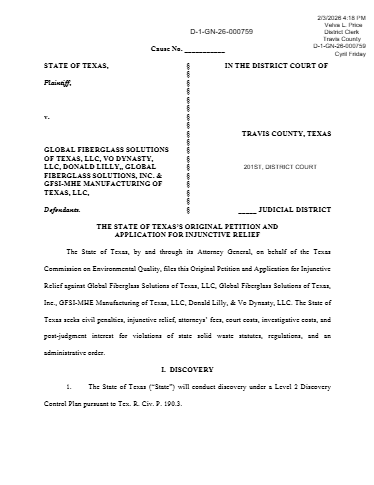
A judge issued a temporary injunction requiring Global Fiberglass Solutions and affiliated companies to immediately stop accepting new wind turbine blades and to begin properly disposing of the existing material at authorized facilities.
The state alleges Global Fiberglass Solutions was hired by multiple companies to break down, transport and recycle retired wind turbine blades but instead stockpiled more than 3,000 blades and turbine parts at two Sweetwater facilities.
The state calls the locations illegal disposal sites and says they …
... more [truncated due to possible copyright]Sweetwater, Texas — More than 3,000 wind turbine blades that have been piled at two sites in Sweetwater for years must now be cleaned up under a court order that also stops any new shipments from coming in.
A judge issued a temporary injunction requiring Global Fiberglass Solutions and affiliated companies to immediately stop accepting new wind turbine blades and to begin properly disposing of the existing material at authorized facilities.
The state alleges Global Fiberglass Solutions was hired by multiple companies to break down, transport and recycle retired wind turbine blades but instead stockpiled more than 3,000 blades and turbine parts at two Sweetwater facilities.
The state calls the locations illegal disposal sites and says they violate Texas environmental laws.
Attorney General Ken Paxton filed the lawsuit in February, asking the court to require the company to remove the waste and stop bringing in additional turbine blades.
Paxton called the ruling a victory for protecting Texas land, health and safety, saying the state will not allow Texas to become an illegal dumping ground.
In February, the City of Sweetwater acknowledged the issue in a public letter, saying it had been a longtime concern for the community as the state’s lawsuit moved forward.
Photos included in the state’s court filings show rows of wind turbine blades covering much of the property, including stacks inside a fenced portion of one site.
Another photo shows the piles from State Highway 70, where they have been a familiar sight for people driving by.
In a statement provided to KTXS News, Sweetwater Economic Development Executive Director Miesha Adames said responsibility for complying with the court’s injunction rests with Global Fiberglass Solutions and will be overseen by the Texas Commission on Environmental Quality and the Texas Attorney General’s Office.
Adames said neither the City of Sweetwater nor Sweetwater Economic Development has regulatory authority over the property or the cleanup.
KTXS News received this official statement from Executive Director, Miesha Adames with Sweetwater Economic Development, This is a statement Regarding the Global Fiberglass Solutions Temporary Injunction.
The statement said the injunction requires Global to begin the cleanup process within 180 days and sets additional deadlines over roughly the next 550 days, with enforcement left to the courts and TCEQ.