
Oklahoma’s transformation into a power plant demands honest accounting
Lisa Linowes|Oct 1, 2025
Oklahoma has become a massive electricity production zone. The benefits to developers and distant corporations are clear; the costs to communities and ratepayers are mounting. Oklahomans are left with the land-use transformation, reliability backstops, and environmental risks—without the tools to manage them.
Oklahoma has become a massive electricity production zone. The benefits to developers and distant corporations are clear; the costs to communities and ratepayers are mounting. Oklahomans are left with the land-use transformation, reliability backstops, and environmental risks—without the tools to manage them.
Over the last decade, Oklahoma has quietly undergone one of the most sweeping land-use conversions in its history. Roughly 85 wind projects, 5,600 turbines, and nearly 13,000 megawatts (MW) of capacity now stretch across millions of acres. This is not boutique development—it is an industrial buildout of extraordinary scale. 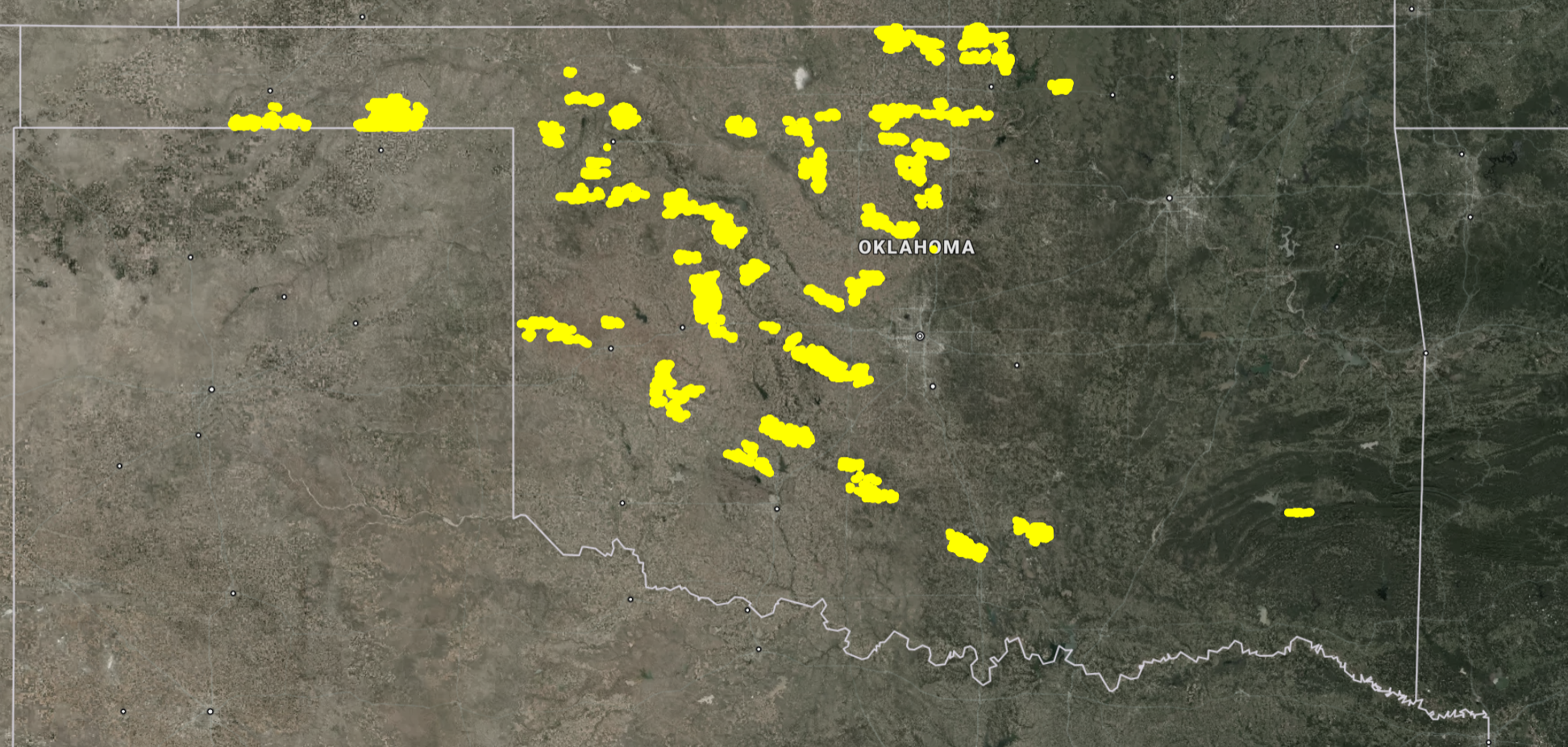
In 2010, Oklahoma had about 1,480 megawatts of wind. By 2024, the fleet had grown nearly ninefold. Between 2019 and 2022 alone, developers added roughly 3,500 megawatts—thousands of turbines deployed faster than communities, wildlife managers, and grid operators could adapt. Oklahomans deserve an honest accounting of what this means for their state. (Image source: screen capture of USGS wind turbine viewer)
A Power Mix Transformed
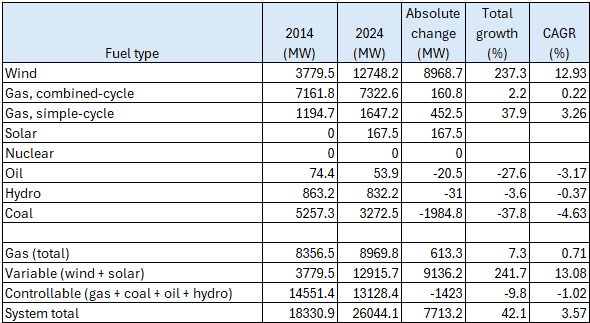
Between year-end 2014 and year-end 2024, Oklahoma’s installed wind capacity grew by nearly 9,000 MW, while coal fell by 2,000 MW and gas rose just 600 MW (mostly peakers). In net, variable resources (wind+solar) added ~9,100 MW even as controllable capacity declined by ~1,400 MW. Wind alone accounts for ~116% of the state’s net capacity growth over the period—because retirements elsewhere offset part of that buildout.
The results are visible. Oklahoma already produced 24% more electricity than it consumed in 2015; by 2024, the surplus reached 31%. Installed capacity grew 30% faster than demand—enough to power an additional 600,000–700,000 homes. Much of that power is shipped out of state under long-term contracts to corporations like Meta, Amazon, Google, Walmart, and Starbucks, or to utilities in the Southeast. Most Oklahoma households, meanwhile, consume untagged grid electricity without the renewable attributes attached. (See Table. Installed capacity figures from US Energy Information Administration)
Not a Market Story—A Subsidy Story
This surge wasn’t pulled by in-state demand; Oklahoma already has a glut of generation. Nor was it required by a state mandate. It was pushed by federal policy and permissive siting. Production Tax Credits (PTCs) pay per megawatt-hour generated, regardless of local demand conditions, so projects can “pencil” even when market prices are low or negative. Add accelerated depreciation, a strong wind resource, forgiving terrain, long construction windows, and minimal state or local siting constraints—and the investment case is clear. The community protections are not.
Reliability Challenges
Wind is weakest in summer when demand is highest, and strongest at night when demand is low. Generation from projects across the Southwest Power Pool (SPP), the grid control area that contains Oklahoma, tend to rise and fall together under the same weather systems, so output can surge or collapse across the fleet within hours. SPP has reported swings of 13,000 to 16,000 megawatts in a matter of hours—the equivalent of 13 to 16 nuclear plants turning on or off, or ten million households’ demand appearing or disappearing.
To manage this volatility, operators must keep extra capacity online, commit fast-start units, and procure reserves. Those costs are not embedded in the price of wind; they are layered on top and ultimately borne by customers.
Who Benefits?
For capacity installed between 2015 and 2024 (includsive), Production Tax Credits alone total about $9.2 billion, paid over a project’s first 10 years (excluding accelerated depreciation and any energy-market revenue).[1] By contrast, local benefits are modest and slow-drip—about $100 million per year in property taxes and $100 million per year in landowner leases across the fleet, roughly $4 billion over 20 years. The imbalance is obvious: developers and investors capture large, front-loaded federal subsidies, while host communities receive comparatively smaller long-term payments and live with the industrial footprint and environmental risks.
Environmental and Safety Harms
Environmental impacts are poorly documented. Consider the Thunder Ranch Wind project—a 298 MW facility contracted to Anheuser-Busch. Turbines sweep prime whooping-crane migratory habitat and bald-eagle territory, yet comprehensive post-construction wildlife data are not publicly available. Multiply that uncertainty across 85 projects and the state has little idea what cumulative harm has been done to birds, bats, and ecosystems.
Public-safety and nuisance impacts are no less pressing. Since 2017, at least 14 catastrophic turbine failures have been reported in Oklahoma—blade throws, fires, and collapses, averaging about two per year. Neighbors live with intrusive noise, shadow flicker, and aviation lighting. Protections under Oklahoma law are weak, reflecting an outdated regulatory posture.
Time to Act
Oklahoma has become a massive electricity production zone. The benefits to developers and distant corporations are clear; the costs to communities and ratepayers are mounting. Oklahomans are left with the land-use transformation, reliability backstops, and environmental risks—without the tools to manage them.
Other states and countries require safe setbacks, advanced lighting controls (ADLS), objective noise limits, shadow-flicker mitigation, and full decommissioning bonds. These are practical, enforceable, and proven.
Clean energy and rural quality of life are not mutually exclusive. But if Oklahoma is to remain a host, it must adopt clear rules that balance benefits and burdens. Without that balance, the state isn’t exporting a product. It’s giving itself away.
[1] PTC value is based on 8,969 MW installed, capacity factor of 39%, $30 PTC value per MWh over ten years. (8969 MW * .39 * 8760 hr/year * $30/mwh * 10 years = $9.19 billion)