Order denying Invenergy motion for summary judgement - Noise impacts
Justia|Justice Jeremiah J. McCarthy|Jul 14, 2022
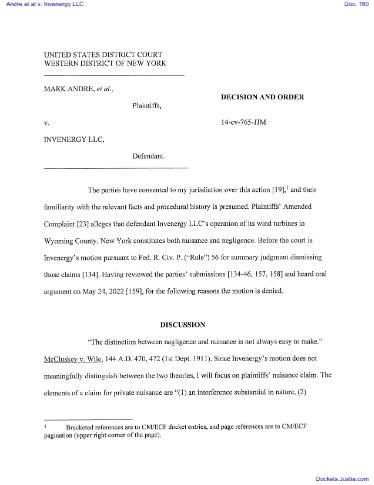
This important case (Case Number: 1:14-cv-00765) in the U.S. District Court for the Western District of New York, neighbors led by Mark Andre sued Invenergy saying the noise from wind turbines in Wyoming County made their properties unpleasant to use and even caused health problems like migraines and poor sleep. In July 2022 the judge refused Invenergy’s request to throw out the nuisance claim, saying there was enough disagreement about how serious and unreasonable the noise was that the case should go to a jury. After that ruling the parties reached a settlement, the details of which are confidential. The response of the judge is informative. An excerpt is provided below. The full decision can be downloaded from the document links on this page.
This important case (Case Number: 1:14-cv-00765) in the U.S. District Court for the Western District of New York, neighbors led by Mark Andre sued Invenergy saying the noise from wind turbines in Wyoming County made their properties unpleasant to use and even caused health problems like migraines and poor sleep. In July 2022 the judge refused Invenergy’s request to throw out the nuisance claim, saying there was enough disagreement about how serious and unreasonable the noise was that the case should go to a jury. After that ruling the parties reached a settlement, the details of which are confidential. The response of the judge is informative. An excerpt is provided below. The full decision can be downloaded from the document links on this page.
Excerpt from the order:
Substantiality of the Interference
“To be substantial, the interference must not be fanciful, slight, or theoretical, but certain and substantial, and must interfere with the physical comfort of the ordinarily reasonable person.” Boomer v. Thorbald, 2007 WL 2455133, *5 (S.D.N.Y. 2007), aff’d, 310 F. App’x 429 (2d Cir. 2009).
I previously ruled that plaintiffs’ claims of “sleep deprivation, headaches, anxiety [and] teeth grinding … do not require expert proof, and are adequately supported by plaintiffs’ testimony,” May 6, 2021 Decision and Order [Dkt. 114] at 4. While Invenergy “does not seek to dispute that plaintiffs identified symptoms,” Defendants’ Memorandum of Law [Dkt. 146] at 39–40, it argues that “the evidence does not support a finding that the effects alleged … are ‘substantial’ …” Id. at 40. Invenergy points, for example, to plaintiffs’ trial testimony that some plaintiffs “sleep in their cars or under the window in the middle of their property” (Tr. 518–20), and plaintiffs’ Trial affidavits that the noise caused them to “buy $1.00 ear plugs in the truck,” (Dkt. 78 ¶ 9), and “don’t wear 24/7.” Id. While Invenergy argues “[p]laintiffs have not shown any foundation, beyond their own conclusory assertions, that the symptoms they attribute to wind turbines have any evidentiary basis,” Defendants’ Memorandum of Law [Dkt. 146] at 40, that argument goes to the weight of the evidence – and in deciding this motion, I must accept the evidence as true, or assess the credibility of witnesses. Sakosky v. Frinzi, 84 F.3d 54, 59 (2d Cir. 1996). Instead, for purposes of this motion, plaintiffs’ testimony “is to be believed.” St. Pierre Associates v. Yoder, 993 F.2d 917, 921 (2d Cir. 2001).
That testimony creates at least a reasonable inference that the interference with plaintiffs’ use and enjoyment of their property was more than “fanciful, slight, or theoretical.” If, at the time of a motion where summary judgment is sought, there is any evidence in the record from which a reasonable inference could be drawn in favor of the nonmoving party, summary judgment is improper. Anderson v. Liberty Lobby, Inc., 477 U.S. 242, 255 (1986); American International Group, Inc. v. London American International Corp., 664 F.2d 348, 351 (2d Cir. 1981) (“[i]f the trier could reasonably draw inferences against the moving party, summary judgment is improper, even if the trier could also reasonably draw inferences in favor of the moving party.”).
Therefore, Invenergy has failed to demonstrate that there is no issue of fact as to the substantiality of the interference. See Boomer v. Thorbald, 2007 WL 2455133, at *5 (S.D.N.Y. 2007) (“to be ‘substantial’ an interference is not so inconsequential that no reasonable person could consider it to be real”). Specific examples include wind turbine noise producing “sleep disturbance, headaches, anxiety, specific restrictions upon social interaction, and loss of enjoyment of life,” which were held sufficient to demonstrate a triable issue of fact as to the substantiality of the interference. See also Stiglianese v. Vallone, 106 A.D.2d 634 (2d Dep’t 1984).