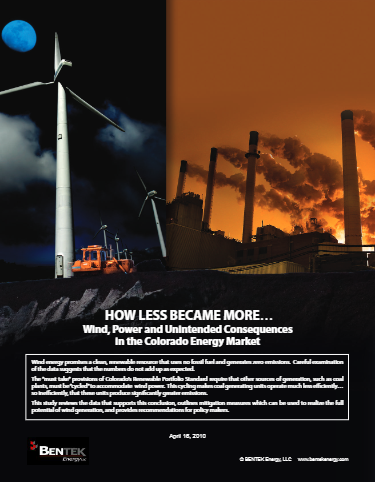
How Less Became More: Wind, power and unintended consequences in the Colorado energy market
Bentek Energy LLC|Apr 16, 2010
Wind energy promises a clean, renewable resource that uses no fossil fuel and generates zero emissions. Careful examination of the data suggests that the numbers do not add up as expected. The “must take” provisions of Colorado’s Renewable Portfolio Standard require that other sources of generation, such as coal plants, must be “cycled” to accommodate wind power. This cycling makes coal generating units operate much less efficiently… so inefficiently, that these units produce significantly greater emissions. This study reviews the data that supports this conclusion, outlines mitigation measures which can be used to realize the full potential of wind generation, and provides recommendations for policy makers.
Wind energy promises a clean, renewable resource that uses no fossil fuel and generates zero emissions. Careful examination of the data suggests that the numbers do not add up as expected. The “must take” provisions of Colorado’s Renewable Portfolio Standard require that other sources of generation, such as coal plants, must be “cycled” to accommodate wind power. This cycling makes coal generating units operate much less efficiently… so inefficiently, that these units produce significantly greater emissions. This study reviews the data that supports this conclusion, outlines mitigation measures which can be used to realize the full potential of wind generation, and provides recommendations for policy makers.
The below is a summary of the findings of this important report. The full report can be downloaded directly from this page by clicking on the document icon.
According to advocates, renewable energy will not only be a major tool to reduce our carbon output, but also, by displacing coal and natural gas, renewable energy will reduce smog and ther air pollution, presumably by reducing sulfur dioxide (SO2) and nitrous oxides (NOX), principal components of ozone and smog.
This report, sponsored by the Independent Producers Association of Mountain States, concludes that the emissions benefits of renewable energy are not being realized as planned based on examination of four years of Public Service Company of Colorado (PSCO) operational history. Integrating erratic and unpredictable wind resources with established coal and natural gas generation resources requires PSCO to cycle its coal and natural gas-fired
plants.3 Cycling coal plants to accommodate wind generation makes the plants operate inefficiently, which drives up emissions. Moreover, when they are not operated consistently at their designed temperatures, the variability causes problems with the way they interact with their associated emission control technologies, frequently causing erratic emission behavior that can last for several hours before control is regained. Ironically, using wind to a degree that forces utilities to temporarily reduce their coal generation results in greater SO2, NOX and CO2 than would have occurred if less wind energy were generated and coal generation were not impacted.