Rail Tie wind project: Legal complaint opposing approval
Dec 23, 2024
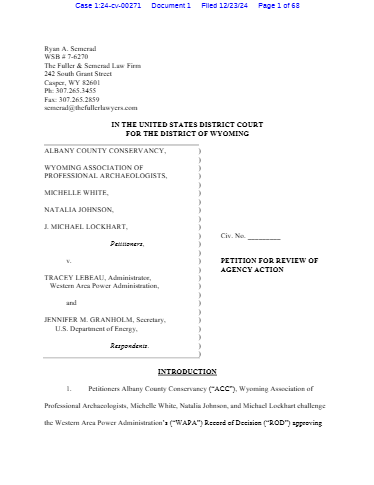
Plaintiffs in Wyoming filed this complaint against the U.S. government's approval to interconnect the 504 megawatt Rail Tie wind project to a transmission line controlled by the government. Due to the federal aspect of this project, a NEPA environmental review was required. The Western Area Power Administration (“WAPA”) is the agency empowered with issuing a Record of Decision (“ROD”) approving the project. The plaintiffs argue WAPA failed to follow the NEPA process in approving this project. A portion of the filing is provided below. The full complaint is available at the document links on this page.
Plaintiffs in Wyoming filed this complaint against the U.S. government's approval to interconnect the 504 megawatt Rail Tie wind project to a transmission line controlled by the government. Due to the federal aspect of this project, a NEPA environmental review was required. The Western Area Power Administration (“WAPA”) is the agency empowered with issuing a Record of Decision (“ROD”) approving the project. The plaintiffs argue WAPA failed to follow the NEPA process in approving this project. A portion of the filing is provided below. The full complaint is available at the document links on this page.
Record of Decision
89. Three months after the ACC’s last correspondence, WAPA Administrator Tracey Lebeau signed the ROD authorizing the Project’s interconnection on July 11, 2022. The ROD was published in the Federal Register eight days later. See 87 Fed. Reg. 43,022, 43,022-28 (July 19, 2022).
90. The ROD is disingenuous when characterizing the thrust of WAPA’s decision. After saying nothing to this effect in its scoping notice, DEIS, or FEIS, WAPA’s ROD implies that WAPA may only “deny an interconnection request” if “operation of the power system would [] be negatively affected,” the applicant declines to fund “any necessary system upgrades,” or “existing power customers would [] be impacted,” ROD at 3. However, the ROD inexplicably and arbitrarily omits the terms of its own Tariff, which authorizes WAPA to deny an interconnection request based on the findings of its NEPA review. See Tariff, Attach. L at 44 (“[WAPA]’s NEPA review could result in a decision not to execute the [Large Generator Interconnection Agreement (LGIA)], or to delay LGIA execution.”]. The ROD also selectively fails to mention that WAPA retains discretion to “negotiate[]” and adopt mitigation measures—through consideration of reduced-impact alternatives—and that WAPA may deny an interconnection request in the absence of “a commitment from the applicant that its proposed mitigation will be implemented.” Guidance, Attach. E at 5. Indeed, WAPA’s guidance explains that “[a]n EIS usually contains mitigation that will lessen certain impacts,” including “avoiding impacts by not taking certain actions; minimizing impacts by limiting the degree of magnitude of the action; [and] rectifying the impact by repairing, rehabilitating or restoring the affected environment . . . .” Id., Attach. E at 4-5.
91. The ROD reiterates the FEIS’s head-scratching defense of its unreasonably slender alternatives analysis—claiming on one hand that without WAPA’s interconnection agreement, “the Project would not be built,” while also claiming that the Project’s “operation” does not involve any “participation” by WAPA and, therefore, “could proceed regardless of WAPA’s involvement.” ROD at 4, 6-7.
92. The self-serving logic underpinning WAPA’s alternatives analysis is also on full display in the ROD’s selection of the “environmentally preferred alternative,” which WAPA identifies as the no-action alternative. Id. at 10 (“WAPA has identified the No Action Alternative as its Environmentally Preferred Alternative as none of the identified Project-related impacts would occur, including the potentially significant visual impacts and risk of eagle mortality.”). However, as explained, the rationale for WAPA’s selection directly conflicts with its reason for excluding the Project as a “major Federal action”—because “ConnectGen’s decision to construct [its] Project could proceed regardless of WAPA’s involvement if the Project could interconnect with other non-WAPA transmission lines with sufficient available transmission capacity.” Id. at 7. Given that the Project will purportedly proceed “regardless of WAPA’s involvement,” it is difficult to understand why “[t]he beneficial impacts of renewable energy generation would also not occur” if the no-action alternative were chosen. Id. at 10. Neither WAPA’s ROD nor its FEIS explains this patently arbitrary discrepancy.
93. In its summary of impacts, the ROD concedes that “large wind turbines would result in an obvious man-made change to the existing visual environment that would be seen for a considerable distance,” and could pose a threat to nighttime aerial navigation, but concludes that this effect “would be greatly reduced” if mitigation measures are approved by the Federal Aviation Administration. Id. at 7-8. The ROD fails to explain whether such impacts are acceptable to WAPA in the absence of such mitigation, or whether its approval of the interconnection request is contingent on the Federal Aviation Administration requiring those mitigation measures and ConnectGen expressly committing to undertake them.
94. Next, the ROD acknowledges that the Project will have significant visual impacts on historic resources near the Project, including the Ames Monument NHL. Id. at 8. Nevertheless, the ROD shrugs off any concern over those effects by pointing to “avoidance, minimization, and mitigation measures” that might be imposed through the NHPA process, even though that process, at the time WAPA issued its ROD, remained ongoing and far from a conclusion. Id.
95. The ROD also recognizes that the Project’s construction and operation will result in a “significant” number of eagle fatalities each year. Id. (“Preliminary information suggests that there could be multiple eagle fatalities per year resulting from operation of the Project.”). Yet, here too, the ROD quickly points to unformulated mitigation measures, including a “spatial buffer around known eagle nests” and ConnectGen’s unenforceable promises to prepare “an eagle conservation plan” and apply “for an eagle incidental take permit from the U.S. Fish and Wildlife Service.” Id. While the ROD goes to great lengths to describe FWS’s obligations under BGEPA, it conveniently sidesteps any explanation of WAPA’s duty under NEPA. Indeed, in both the ROD and FEIS, WAPA never analyzes whether or explains why (let alone how) ConnectGen’s hypothetical “eagle conservation plan” will reduce the Project’s impacts to eagles. Nor does it ever explain whether anticipated impacts on local eagle populations are acceptable to WAPA in the absence of any defined eagle mitigation measures that are binding on ConnectGen,
or whether its approval of the interconnection request is contingent on those measures being developed and implemented only once FWS has provided its authorization under BGEPA.5
96. In addition to the hypothetical mitigation measures mentioned above, the ROD also makes clear that “[t]he design features, best management practices, and avoidance and minimization measures,” which are briefly mentioned in table 2-6 of the FEIS and “incorporated into the Project’s committed Environmental Protection Measures,” “are considered an integral part of the proposed Project to be implemented by ConnectGen,” and “reflect all practicable means to avoid or minimize environmental harm from the Project.” Id. at 5-6 (emphasis added). The ROD, however, fails to explain how WAPA reached this conclusion when the vast majority, if not all, of the measures have yet to be developed.
97. With respect to cumulative impacts, the ROD briefly addresses two wind energy projects identified by the ACC in its pre-ROD letters. However, as with the FEIS, WAPA only considered in the ROD as part of its cumulative impact analysis how those projects would affect certain resources such as public health and safety, social and economic, and transportation resources. WAPA neither considered cumulative environmental impacts (such as those to the local area population of bald and golden eagles), nor explained why it excluded environmental effects from its discussion of cumulative impacts. WAPA also failed to consider cumulative impacts to historic and cultural resources.
98. According to WAPA’s project website—with the exception of the NHPA consultation documents discussed below—WAPA evidently has not conducted (or at least publicly disclosed) any of the myriad resource impact reports and studies that it promised would occur, albeit without public comment and meaningful involvement, after WAPA issued the ROD. See WAPA, Rail Tie Wind Project, https://www.wapa.gov/ transmission/transmission-environmental -review-nepa/rail-tie-wind-project/.
99. In October 2024, WAPA published a cursory “Mitigation Action Plan” on its project website. That plan “summarizes the measures documented in the [ROD] and [HPTP] to mitigate potential adverse environmental impacts of the [Project].” While asserting erroneously that “[e]nvironmental protection measures that are integral to the Project . . . were evaluated in the EIS,” the Mitigation Action Plan acknowledges that ConnectGen has not yet developed the plans necessary to mitigate the Project’s impacts—i.e., WAPA references “the plans ConnectGen will develop for implementing [] protection measures . . . to avoid or minimize adverse environmental impacts,” and notes that this Plan “may be revised as more specific and detailed information becomes available.” The entirety of the “Plan” for mitigation action by WAPA and ConnectGen consists of a half-page table summarizing high-level (rather than site-specific) mitigation strategies such as at least “one-mile spatial buffer[s] around known eagle nests,” and “[p]repare an eagle conservation plan.” Nowhere in this brief “plan” does WAPA explain in any detail how each mitigation measure “will be planned and implemented,” as required “before DOE takes any action directed by the ROD that is the subject of a mitigation commitment.” 10 C.F.R. § 1021.331(a). Nor is this plan “as complete as possible.” Id. § 1021.331(c).
Footnote 5 On information and belief, FWS has not begun processing—let alone issued—an incidental take permit under BGEPA for ConnectGen/Repsol in connection with this Project. Until and unless such a permit is issued, the Project proponent seriously threatens to violate BGEPA through construction and/or operation activities that could disturb, harass, kill, or otherwise take bald or golden eagles. This is why obtaining a permit before Project construction commences is essential; such a permit will invariably require siting modifications to avoid or reduce harm to eagles, which must be incorporated into any project design before the start of construction.