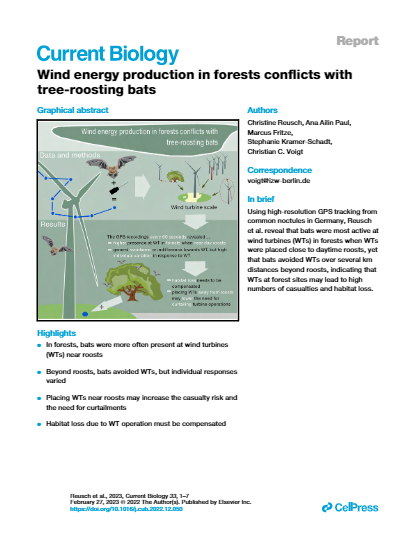
Wind energy in forests conflict with tree roosting bats
Current Biology|Christine Reusch, Ana Ailin Paul et.al. |Jan 20, 2023
This important paper examines the harmful impact of wind turbines erected near bat roosts. The highlights and summary of the paper are provided below. The full report can be accessed at the document links on this page.
This important paper examines the harmful impact of wind turbines erected near bat roosts. The highlights and summary of the paper are provided below. The full report can be accessed at the document links on this page.
Highlights
• In forests, bats were more often present at wind turbines (WTs) near roosts
• Beyond roosts, bats avoided WTs, but individual responses varied
• Placing WTs near roosts may increase the casualty risk and the need for curtailments
• Habitat loss due to WT operation must be compensated
Summary
Many countries are investing heavily in wind power generation, triggering a high demand for suitable land. As a result, wind energy facilities are increasingly being installed in forests, despite the fact that forests are crucial for the protection of terrestrial biodiversity. This green-green dilemma is particularly evident for bats, as most species at risk of colliding with wind turbines roost in trees.2 With some of these species reported to be declining, we see an urgent need to understand how bats respond to wind turbines in forested areas, especially in Europe where all bat species are legally protected. We used miniaturized global positioning system (GPS) units to study how European common noctule bats (Nyctalus noctula), a species that is highly vulnerable at turbines,9 respond to wind turbines in forests. Data from 60 tagged common noctules yielded a total of 8,129 positions, of which 2.3% were recorded at distances <100 m from the nearest turbine. Bats were particularly active at turbines <500 m near roosts, which may require such turbines to be shut down more frequently at times of high bat activity to reduce collision risk. Beyond roosts, bats avoided turbines over several kilometers, supporting earlier findings on habitat loss for forest-associated bats.10 This habitat loss should be compensated by developing parts of the forest as refugia for bats. Our study highlights that it can be particularly challenging to generate wind energy in forested areas in an ecologically sustainable manner with minimal impact on forests and the wildlife that inhabit them.