Document
DECISION: Oregon-California Trails Association v. Walsh, 061720 CODC, C. A. 19-cv-1945-WJM
William J. Martínez United States District Judge|Jun 17, 2020
This important court order involves a decision by the US Fish and Wildlife Service to issue an incidental take permit that allows a transmission line to be constructed in Nebraska where the Oregon Trail leads and where the critically endangered whooping crane migrates through. The court ultimately vacated the take permit and mandated a more thorough review of the impacts on historic resources. A portion of the order is provided below. The full order can be accessed at the document links on this page.
This important court order involves a decision by the US Fish and Wildlife Service to issue an incidental take permit that allows a transmission line to be constructed in Nebraska where the Oregon Trail leads and where the critically endangered whooping crane migrates through. The court ultimately vacated the take permit and mandated a more thorough review of the impacts on historic resources. A portion of the order is provided below. The full order can be accessed at the document links on this page.
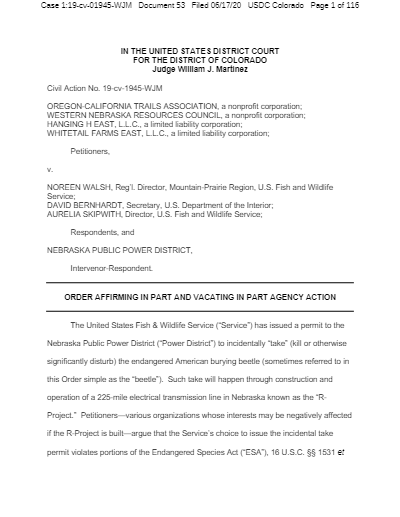
The United States Fish & Wildlife Service (“Service”) has issued a permit to the Nebraska Public Power District (“Power District”) to incidentally “take” (kill or otherwise significantly disturb) the endangered American burying beetle (sometimes referred to in this Order simple as the “beetle”). Such take will happen through construction and operation of a 225-mile electrical transmission line in Nebraska known as the “R-Project.”
Petitioners—various organizations whose interests may be negatively affected if the R-Project is built—argue that the Service’s choice to issue the incidental take permit violates portions of the Endangered Species Act (“ESA”), 16 U.S.C. §§ 1531 et seq.; the National Environmental Policy Act (“NEPA”), 42 U.S.C. §§ 4231 et seq.; and the National Historic Preservation Act (“NHPA”), 54 U.S.C. §§ 300101 et seq. Petitioners thus bring this lawsuit under the Administrative Procedure Act (“APA”), 5 U.S.C. §§ 701 et seq., to have the incidental take permit set aside.
This is an unusually complicated case. The R-Project has been in various planning stages for eight years, and the administrative record is correspondingly enormous. (See ECF Nos. 17–22.) The record is also oddly organized and difficult to navigate. More frustrating, however, are the parties’ arguments. Many are of the underdeveloped, “see what sticks” variety; many are inexcusably belated (i.e., arguments Petitioners make for the first time in their reply brief); and there are a surprising number of seemingly relevant arguments not made.
Having bushwhacked for weeks through this thicket, the Court finds, for the reasons explained below, that a large number of Petitioners’ challenges are without merit. The Court agrees with Petitioners, however, as to the following:
• the Service inadequately considered the effects of the R-Project on the O’Fallon’s Bluff segment of the Oregon and California Trail;
• the Service unlawfully excluded potential wind turbine development in Antelope County, Nebraska, from its analysis (an error which infects various other analyses under the ESA, NEPA, and the NHPA); and
• one portion of a “programmatic agreement” entered into to address NHPA matters is arbitrary and capricious, at least on this record.
As a consequence, the Court will set aside the Service’s decision to grant the June 12, 2019 incidental take permit, meaning said permit will be vacated.
Also before the Court are two motions to file amicus briefs. (ECF Nos. 26, 27.) The Court will deny these motions.