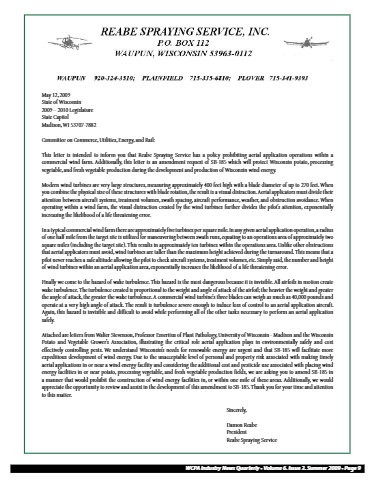
Reabe Spraying Service policy prohibiting aerial application operations
Reabe Spraying Service|Damon Reabe|May 12, 2009
This Reabe Spraying Service letter to the Wisconsin legislature informs the state that the company adopted a policy prohibiting aerial application operations within a commercial wind energy facilities.
This Reabe Spraying Service letter to the Wisconsin legislature informs the state that the company adopted a policy prohibiting aerial application operations within a commercial wind energy facilities.
State of Wisconsin
2009 – 2010 Legislature
State Capitol
Madison, WI 53707-7882
Committee on Commerce, Utilities, Energy, and Rail:
This letter is intended to inform you that Reabe Spraying Service has a policy prohibiting aerial application operations within a commercial wind farm. Additionally, this letter is an amendment request of SB-185 which will protect Wisconsin potato, processing vegetable, and fresh vegetable production during the development and production of Wisconsin wind energy.
Modern wind turbines are very large structures, measuring approximately 400 feet high with a blade diameter of up to 270 feet. When you combine the physical size of these structures with blade rotation, the result is a visual distraction. Aerial applicators must divide their attention between aircraft systems, treatment volumes, swath spacing, aircraft performance, weather, and obstruction avoidance. When operating within a wind farm, the visual distraction created by the wind turbines further divides the pilot’s attention, exponentially increasing the likelihood of a life threatening error.
In a typical commercial wind farm there are approximately five turbines per square mile. In any given aerial application operation, a radius of one half mile from the target site is utilized for maneuvering between swath runs, equating to an operations area of approximately two square miles (including the target site). This results in approximately ten turbines within the operations area. Unlike other obstructions that aerial applicators must avoid, wind turbines are taller than the maximum height achieved during the turnaround. This means that a pilot never reaches a safe altitude allowing the pilot to check aircraft systems, treatment volumes, etc. Simply said, the number and height of wind turbines within an aerial application area, exponentially increases the likelihood of a life threatening error.
Finally we come to the hazard of wake turbulence. This hazard is the most dangerous because it is invisible. All airfoils in motion create wake turbulence. The turbulence created is proportional to the weight and angle of attack of the airfoil; the heavier the weight and greater the angle of attack, the greater the wake turbulence. A commercial wind turbine’s three blades can weigh as much as 40,000 pounds and operate at a very high angle of attack. The result is turbulence severe enough to induce loss of control to an aerial application aircraft. Again, this hazard is invisible and difficult to avoid while performing all of the other tasks necessary to perform an aerial application
safely.
Attached are letters from Walter Stevenson, Professor Emeritus of Plant Pathology, University of Wisconsin - Madison and the Wisconsin Potato and Vegetable Grower’s Association, illustrating the critical role aerial application plays in environmentally safely and cost effectively controlling pests. We understand Wisconsin’s needs for renewable energy are urgent and that SB-185 will facilitate more expeditious development of wind energy. Due to the unacceptable level of personal and property risk associated with making timely aerial applications in or near a wind energy facility and considering the additional cost and pesticide use associated with placing wind energy facilities in or near potato, processing vegetable, and fresh vegetable production fields, we are asking you to amend SB-185 in a manner that would prohibit the construction of wind energy facilities in, or within one mile of these areas. Additionally, we would appreciate the opportunity to review and assist in the development of this amendment to SB-185. Thank you for your time and attention to this matter.
Sincerely,
Damon Reabe
President
Reabe Spraying Service