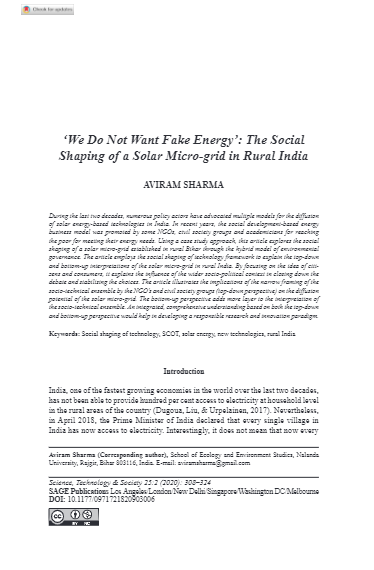
‘We Do Not Want Fake Energy’: The social shaping of a solar micro-grid in rural India
Sage Journals|Aviram Sharma|Mar 5, 2020
This informative paper describes the effort by Greenpeace to promote a solar PV system as a micro-grid solution for rural India. The cost proved to much for the farming communities and the energy was too weak and unreliable. And except of the paper is provided on this page. The full paper can be downloaded from the links on this page
This informative paper describes the effort by Greenpeace to promote a solar PV system as a micro-grid solution for rural India. The cost proved to much for the farming communities and the energy was too weak and unreliable. And except of the paper is provided on this page. The full paper can be downloaded from the links on this page
Abstract
During the last two decades, numerous policy actors have advocated multiple models for the diffusion of solar energy-based technologies in India. In recent years, the social development-based energy business model was promoted by some NGOs, civil society groups and academicians for reaching the poor for meeting their energy needs. Using a case study approach, this article explores the social shaping of a solar micro-grid established in rural Bihar through the hybrid model of environmental governance. The article employs the social shaping of technology framework to explain the top-down and bottom-up interpretations of the solar micro-grid in rural India. By focusing on the idea of citizens and consumers, it explains the influence of the wider socio-political context in closing down the debate and stabilising the choices. The article illustrates the implications of the narrow framing of the socio-technical ensemble by the NGO’s and civil society groups (top-down perspective) on the diffusion potential of the solar micro-grid. The bottom-up perspective adds more layer to the interpretation of the socio-technical ensemble. An integrated, comprehensive understanding based on both the top-down and bottom-up perspective would help in developing a responsible research and innovation paradigm.
Excerpt from the body of the report
During the initial year, the promoters of the project were unable to provide individual electric meter in the households for residential use. Instead of that, two packages were offered. In package one, the consumer had to pay ₹75, and they were allowed to use one bulb and one plug point for charging mobile. Additionally, the users had to pay a security deposit of ₹500 for availing this service. In package two, the consumers had to pay ₹140 and they were allowed to use three bulbs and one plug point. For this package, users were supposed to pay a security deposit of ₹1,000.
In the initial three months after the inauguration of the project, the users faced no problem, as the energy requirement among the users was limited. However, within six months, many of the users have started overusing the power supply and started using other heavy electrical appliances (such as TV, electric heater for preparing food). The micro-grid was not able to continuously generate enough electricity for meeting the increased demand. The unmet expectations and the desire of using more electricity created discontent among the villagers. To overcome this, BASIX and CEED with the help of VLCs conducted a campaign about the do’s and don’ts in terms of using electric appliances. However, the VLC failed to implement those norms for judicious use of the solar connection. Several consumers abandoned their solar connection after this episode in Dharnai. The promoters of the project interpreted the solar micro-grid as a solution to the existing energy poverty of the villagers (CEED, 2014; Greenpeace, 2014b). However, the users were not only interested in solving their immediate concerns but looking for solutions, which were able to meet their increasing energy demand. The idea of hybrid governance (Agrawal & Lemos, 2007), which emphasises joint action by different groups, failed to get operationalised in this context. The local community found it difficult to regulate and manage the project on its own, as envisioned by Greenpeace and associates (Greenpeace, 2014b).
<...>
In the second phase, in January 2016, the promoters of the project installed electric meters in every household. The per unit (kW hour) price of solar energy was fixed at around `9, whereas the per unit price of electricity supplied through the main grid in rural Bihar was around `3. Definitely, there was no financial rationale for using solar energy. Many of the farmers perceived that solar energy is not going to fulfil their energy demands and
is a wasteful option in terms of financial investment. One of the farmers stated that ‘[t]he original energy is provided through the main grid connection, as with that we can irrigate our field and get proper supply. The capacity of solar energy is too low, almost zero in comparison to the main grid.’ The top-down narratives on solar micro-grid, which are led by civil society groups and experts, completely differed from the bottom-up narratives given by the villagers.
Apart from the residential users, the project also envisioned to provide solarbased renewable energy to farmers (Greenpeace, 2014a). Unfortunately, none of the farmers were interested in using the solar energy for irrigation purpose. Agriculture is a major sector in rural Bihar (Sharma & Rodgers, 2015), which requires huge energy supply to sustain different agrarian activities. There were more than 100 diesel-based pumps for irrigation in the village. One of the farmers while comparing solar energy with other sources stated that how can we pay exorbitant prices of solar energy? We do not earn that much from farming. We want an electric connection even for agricultural use. The current electric transformer cannot provide enough electricity to meet our farming needs, that is why most of the farmers are dependent on diesel pumps for irrigating fields; solar energy is unable to meet our agricultural energy demands.