Dr. McMurtry letter to CMOH of Ontario: Wind turbine noise is harming Ontarians
Robert Y. McMurtry MD|Nov 22, 2021
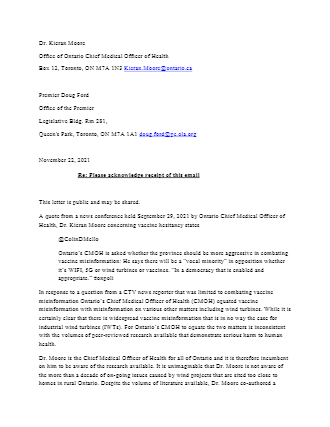
This powerful letter by Dr. Robert Y. McMurtry calls out the repeated failure of the Chief Medical Officer of Health (CMOH) in Ontario and other officials to examine and act on thousands of complaints involvinge adverse effects of wind turbine noise on human health. Such health impacts are on-going. The CMOH has discounted these complaints as misinformation. Key excerpts of the letter are provided below. The full letter can be downloaded from the document link on this page.
This powerful letter by Dr. Robert Y. McMurtry calls out the repeated failure of the Chief Medical Officer of Health (CMOH) in Ontario and other officials to examine and act on thousands of complaints involvinge adverse effects of wind turbine noise on human health. Such health impacts are on-going. The CMOH has discounted these complaints as misinformation. Key excerpts of the letter are provided below. The full letter can be downloaded from the document link on this page.
Key Excerpts From the Letter
Dr. Moore is the Chief Medical Officer of Health for all of Ontario and it is therefore incumbent on him to be aware of the research available. It is unimaginable that Dr. Moore is not aware of the more than a decade of on-going issues caused by wind projects that are sited too close to homes in rural Ontario. Despite the volume of literature available, Dr. Moore co-authored a response to the College of Family Physicians of Canada publication (CFP) titled 'Adverse health effects of industrial wind turbines'. Dr. David Colby is co-author of this response with Dr. Moore. Dr. Colby is also a co-author of the wind industry-backed publication for CANWEA (Canadian Wind Energy Association) and AWEA (American Wind Energy Association) of 2009 titled: 'Wind Turbine Sound and Health Effects: An Expert Panel Review'.
While in the response to the CFP article both doctors asserted they were doing their duty as physicians and public health officers, they virtually dismissed the debilitating health conditions wind turbine neighbours were suffering.
Dr. Colby and Dr. Moore have both appeared on behalf of the Ministry of Environment during legal appeals to Ontario‟s Environmental Review Tribunals [2,3,4]. Both testified against Ontario citizens who provided testimonial evidence under oath of serious harm to health and noise annoyance which is considered an adverse health effect by Health Canada and the World Health Organization [5,6,7]. Indeed it must be said here that with limited involvement of the Public Health office, through the Green Energy Act roll out, the Ministry of Environment has led the policy initiative to install industrial wind turbines.
<…>
As of 2018, documents obtained through a Freedom of Information (FOI) request demonstrate rural residents living near wind energy facilities have submitted about 6,000 Incident Reports/complaints to Ontario’s Ministry of Environment [8]: these Incident Reports continue to be submitted. A review of documents and wind energy developers‟ noise impact reports found that over 30,000 Ontario homes are located within 1,500 metres of an IWT [9]. While the average Canadian household in 2018 consisted of 2.9 people [10], by applying a conservative factor of 2.5 as an approximation of the number of people living in an Ontario home, there are approximately 92,000 people exposed to levels of noise, vibration, shadow flicker, and other factors that had not been previously encountered in their rural living environment [8]. This estimated total of 92,000 is widely distributed throughout Ontario rural areas and is closely equivalent to South Nepean’s population of 92,920 - the sub-area of Ottawa - the Nation’s Capital [11], Based on testimony under oath by the Ministry of Environment‟s expert that stated
“in the range of about 35 to 40 dBA ... about six percent of people will be annoyed or very annoyed ... above 40 dBA, that number jumps to about 20 percent” and that “6 percent is “not trivial”” [12]. As a result, there is an increased risk of adverse health effects and morbidity [7] from noise annoyance for approximately 18,500 people (92,920 x 0.20 = 18,584).
Some, such as: babies, infants, children not yet in school, mothers and care givers of these children, elderly and those who may be unwell and/or may not be mobile could be exposed to these noise levels up to 24 hours a day, 7 days a week. As a requirement of the Green Energy Act each wind turbine installation application had to pass an Environmental Assessment before it was approved which included a noise assessment. This noise assessment is generally performed through predictive computer modelling.
If the thousands of Incident Reports/complaints about adverse effects on human health and the environment were confined to an urban setting of 92,000 people, it is suggested that the CMOH and provincial authorities would have initiated mitigation and resolved the issues being raised by rural residents years ago.
If Dr. Moore had taken the time to review the many studies and reports published on wind turbine effects in the past decade it is highly unlikely he would have made the recent statement with such negative rhetoric about rural residents forced to live in the environs of industrial wind installations to a TV audience.
Dr. Robert McMurtry is a physician and special advisor to the Canadian Royal Commission on the Future of Health Care.McMurtry graduated from the University of Toronto in Medicine in 1965, and is a Fellow of the Royal College of Physicians and Surgeons of Canada.