Offshore wind subsidies per MWh generated continue to rise
Renewable Energy Foundation|Aug 1, 2021
Analysis by Professor Gordon Hughes of the School of Economics at University of Edinburgh shows that the cost of consumer subsidies to offshore wind per unit of electrical energy generated (MWh) has risen and continues to rise year on year. This is contrary to claims by the UK government and other reports that claim these costs are dropping. Below is an excerpt from a report explaining Prof. Hughes's findings. The full report can be accessed by selecting the document link(s) on this page.
Analysis by Professor Gordon Hughes of the School of Economics at University of Edinburgh shows that the cost of consumer subsidies to offshore wind per unit of electrical energy generated (MWh) has risen and continues to rise year on year. This is contrary to claims by the UK government and other reports that claim these costs are dropping. Below is an excerpt from a report explaining Prof. Hughes's findings. The full report can be accessed by selecting the document link(s) on this page.
It is frequently claimed that the subsidy cost of offshore wind farms has fallen over the past few years. The UK government itself is on record as recently as November 2020 claiming that:
Government support to unleash the potential of offshore wind generation has seen the cost of it fall by two thirds in the last 5 years. Echoes of these claims are commonplace.
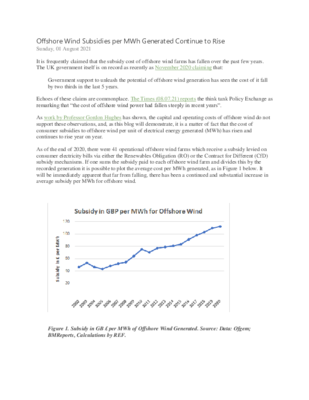
The Times (08.07.21) reports the think tank Policy Exchange as remarking that “the cost of offshore wind power had fallen steeply in recent years”. As work by Professor Gordon Hughes has shown, the capital and operating costs of offshore wind do not support these observations, and, as this blog will demonstrate, it is a matter of fact that the cost of consumer subsidies to offshore wind per unit of electrical energy generated (MWh) has risen and continues to rise year on year.
As of the end of 2020, there were 41 operational offshore wind farms which receive a subsidy levied on consumer electricity bills via either the Renewables Obligation (RO) or the Contract for Different (CfD) subsidy mechanisms. If one sums the subsidy paid to each offshore wind farm and divides this by the recorded generation it is possible to plot the average cost per MWh generated, as in Figure 1 below. It will be immediately apparent that far from falling, there has been a continued and substantial increase in average subsidy per MWh for offshore wind.