U.S. Wind Energy Policy: Correcting the abuse in 100 Days (Introduction)
Lisa Linowes|Feb 8, 2017
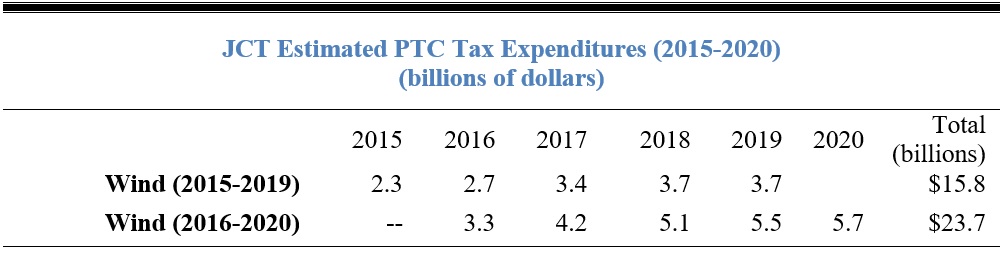
“Obama’s green energy agenda meant advancing wind interests at any cost, and it shows. The Joint Committee on Taxation (JCT) now estimates the total cost of the wind production tax credit in the years 2016–2020 at $23.7 billion.”
“Obama’s green energy agenda meant advancing wind interests at any cost, and it shows. The Joint Committee on Taxation (JCT) now estimates the total cost of the wind production tax credit in the years 2016–2020 at $23.7 billion.”
Land-based wind energy experienced the fastest growth in installed capacity under the Obama presidency, achieving a three-fold increase from 25,000 megawatts (MW) in 2008 to over 75,000 megawatts today. By the end of 2016, wind represented about 5.5% of total U.S. generation (megawatt hours).[1]
The Obama White House, in concert with Senate Democrats, systematically pushed through regulation that dramatically raised wind subsidies, fast-tracked project development, funded policy reports that benefited the sector, and generally placed industry interests ahead of public interests and assets. In several cases, federal law was flouted. Three high-profile court decisions[2] involving wind power delivered embarrassing defeats to the administration in 2015 and 2016 for failing to comply with laws governing wildlife protections. Public opposition to projects has significantly intensified as turbines standing over 500-feet tall were repeatedly sited near homes and sensitive natural habitats. Still, the administration remained unequivocal in its advocacy.
Obama’s green energy agenda meant advancing wind interests at any cost and it shows. The Joint Committee on Taxation (JCT) now estimates the total cost of the wind production tax credit in the years 2016-2020 at $23.7 billion.[3] This represents a 50% increase over the JCT’s prior estimate for the years 2015-2019 and before the PTC phase-out was enacted. The JCT has not released a cost estimate for the full PTC phase-out.
Last month, treasury secretary nominee Steven Mnuchin told the Senate Finance Committee that he would retain and support the PTC phase-out but that might change once President Trump is made aware of the cost and true impacts of Big Wind.
During the month of February, we will be posting a series articles that examine wind energy in the U.S. and offer specific recommendations that, if implemented by the new administration, will help reset priorities and ensure the interests of the American people come first. These posts are not intended to present a long-term comprehensive exposé of federal wind energy policy. Rather, the focus will be on immediate steps to consider during the first one-hundred days of the Trump presidency.
The following briefly summarize some of the issues we will be examining this month.
1) Tax Reform and IRS Guidance. Trump’s plan to lower the corporate tax rate to below 20% will greatly reduce the tax equity market and lessen the incentive for investors to put their money into costly wind projects. We encourage tax reform to get underway as soon as possible, but before that happens, the administration should also review and revise the various IRS guidance notices governing the PTC “start construction” provision of the tax code. The IRS has incrementally relaxed the requirements defining “start construction” and, in doing so, has effectively transformed the PTC phase-out into a full five-year PTC.
2) Department of Energy (DOE) Advocacy. Obama’s DOE has released numerous wind-advocacy reports including its 2015 Wind Vision: A New Era for Wind Power in the United States[4] which promoted the administration’s unrealistic claim that wind power can provide 20-35% of total U.S. electricity generation. DOE’s wind advocacy has also extended to topics outside its core proficiencies including property value impacts and turbine noise assessments. Despite obvious limitations in DOE’s methodologies, wind proponents repeatedly use these government-sponsored reports to silence the public and discredit experts who have testified to results that contradict DOE’s claims.
3) Wind and Military Radar Assets. The Department of Defense (DOD) ‘Siting Clearinghouse’ was always advertised as a ‘one-stop’ service for industry to ensure project compatibility with military operations and radar, but the true intent was very different. With the Clearinghouse, the White House successfully removed uncooperative base commanders from objecting to project sites and expressly prohibited the Secretary of Defense from objecting to any energy project unless, after all other technical mitigations were adopted, the project still proved to produce “an unacceptable risk” to national security.” As long as President Obama was in office it was unlikely any project that impacted military operations would be found unacceptable. There is no question the Clearinghouse has benefited wind developers. What we have not been able to determine is the degree to which military operations have been degraded in the name of wind power.
Over the next weeks, these and other issues will be discussed in more detail.
____________________________________
[1] The most recent information covers the period from January-November 2016. U.S. Energy Information Administration (EIA) Electric Power Monthly Table ES1.B https://www.eia.gov/electricity/monthly/current_year/january2017.pdf
[2] Case 1: Onda v. Jewell, Case 2: Bundorf v. Jewell, Case 3: 30-Year Eagle Take
[3] Wind is expected to receive 92% of the total PTCs awarded in the years 2016-2020.
[4] WindVision: A New Era for Wind Power in the United States. 2015. Washington, DC: Department of Energy. DOE/GO-102015-4557.This document can also be found on the Joint Committee on Taxation website at https://energy.gov/windvision .
[5] DOE’s Vision claims 10% of U.S. electricity demand can be met with wind power by 2020, 20% by 2030, and 35% by 2050. At the end of 2015, more than 50% of the wind energy operating in the U.S. was sited in just five states: Texas (18 GW), Iowa (6.2 GW), California (6.1 GW), Oklahoma (5.2 GW), and Illinois (3.8 GW), By 2050, DOE claims Texas, Iowa and Illinois could EACH have 60 GW or more of wind installed.
[6] Wind farms, residential property values, and rubber rulers. Albert R. Wilson - February 16, 2010 https://www.windaction.org/posts/24661-wind-farms-residential-property-values-and-rubber-rulers#.WEX1M_krIuU
[7] P.L. 111 Section 358 (Ike Skelton National Defense Authorization Act for Fiscal Year 2011)